
NITH Kosal
Research Associate
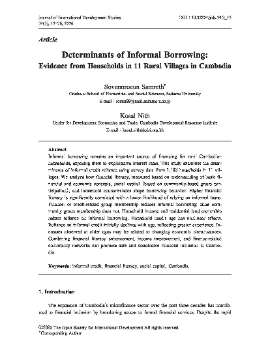
Informal borrowing remains an important source of financing for rural Cambodian households, exposing them to exploitative interest rates. This study examines the determinants of informal credit reliance using survey data from 1,183 households in 11 villages. We analyze how financial literacy, measured based on understanding of basic financial and e...
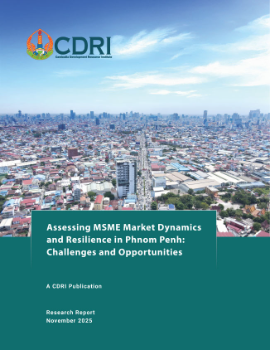
This report examines the market dynamics and resilience of micro, small, and medium enterprises (MSMEs) in Khan Meanchey, Phnom Penh, based on data from 14,820 establishments. MSMEs are deeply embedded in the urban economy, with nearly every household engaged in business activity. Despite a strong post-pandemic recovery in 2023, early signs of...
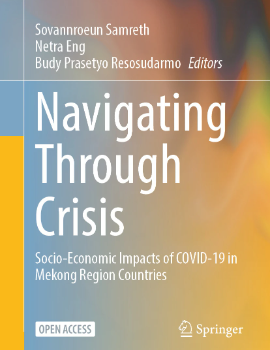
Although the agriculture sector in Cambodia was initially considered less vulnerable to the COVID-19 pandemic, cassava farmers experienced severe economic hardship due to the increase in input prices, fluctuations in output prices, and challenges in infrastructure development. However, these aggregate impacts hide the disproportionate repercussions...

Although Cambodia has a strong ambition to become an upper middle-income nation by 2030 and a high income by 2050, it faces various challenges in achieving these goals. This study investigates Cambodia’s progress and potential in this regard by analysing its position and trajectory relative to Greenfield Foreign Direct Investment (FDI) inflows...
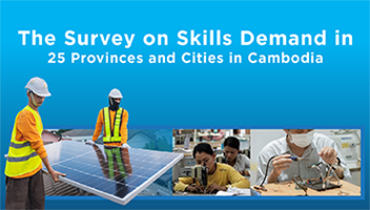
This nationwide survey, conducted by the Cambodia Development Resource Institute (CDRI) in partnership with the Ministry of Labour and Vocational Training (MLVT), assesses current and emerging skills demand across provinces and municipalities in Cambodia. The study supports the recalibration of the TVET 1.5M Programme by identifying priority sk...
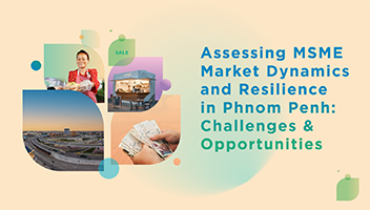
Micro, small, and medium enterprises (MSMEs) form the backbone of Phnom Penh’s urban economy, yet they are increasingly pressured by economic slowdown, and digital disruption. High business turnover reflects survival-driven entrepreneurship, with most firms remaining informal, micro-scale, and concentrated in low-productivity sectors. Given the...
The CDRI Economic Updates provide regular updates on the state of the economy, specifically by tracking the economic cycle of wealth in Cambodia at both the macroeconomic and micro-household and business levels. It provides a brief summary of economic trends and their implications for each quarter, explaining the potential drivers of the curre...

CDRI has been conducting the Moving out of Poverty (MOP) survey since 1996/1997 in 3 village household samples and this sample have been extended 11 villages across 7 provinces by 2020. CDRI surveys the same 1000 households every three years to track the poverty dynamics across the five main regions of Cambodia. This rare longitudinal dataset i...
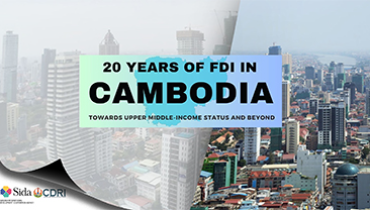
The assessment of the development potential of inward FDI (IFDI), and its complementarity with outward FDI (OFDI), in terms of creation/destruction and specialisation/diversification of national, regional and local economic activities, sectors and functions, employment, skills and innovation is all the more urgent to enhance the understanding o...
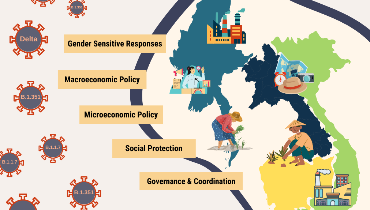
In close coordination with local governments and organizations, the project will identify gender-sensitive policies and good practices from the macro to micro level that will support the recovery process and improve resilience among vulnerable women workers and micro, small, and medium enterprises. It will facilitate policy dialogue and coordin...